FIELD TRIPS
start page
2004-2005

June 13, 2005. Field Trip to Hamilton/ Trenton Marsh. Photos by Nicole Llull.


On October 24, 2004 Marc Stempel invited Club members to a field trip to Plainsboro Preserve.  Nicole Llull took the photos:


2003-2004

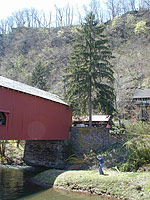
A group of photographers under the leadership of Marc Stempel participated in a field trip to PA and NJ covered bridges (April 25, 2003). The weather was perfect and everybody enjoyed this trip. 

A little bit of history:
The Frequently Asked Question about covered bridges has to be: why were they covered? There is a short answer. Wooden bridges with exposed superstructures are vulnerable to rot. Covering and roofing them protects them from the weather, and so they last longer. In one sense, that just puts off the question. Why so many wooden bridges? And why especially in Pennsylvania and the U. S. Northeast?
In eighteen hundred, the northeastern United States was a country in need of bridges. It is a fairly narrow coastal plain cut by many short rivers and creeks. In the "tidewater" region, these little streams and the great estuaries such as the Chesapeake and Delaware Bays had been highways and lifelines. But now the population was surging beyond the tidewater region, drawn both by the growth of agriculture and the call of water-powered industrialization. Inland farmers needed overland transport, and that meant fords or bridges. But the water-powered mills sought out the very places where the streams could not be forded -- the falls and rapids -- and they too needed transportation.
So bridges were needed. The American northeast was a forest country: wood was a plentiful building material, especially in the remote areas where the smaller bridges were needed. And the climate favored wooden construction. The climate of the region is harsh, by European standards -- hot in the summer and icey in the winter, with a freeze-thaw cycle that would overturn stone pavings.


Photos by Olga Sergyeyeva.


On June 2d, 2002 a group of photographers under the leadership of Marc Stempel and George Vogel  ventured to the Water Gap National Park. Among the many beautiful sights were Dingman's Falls. The weather was perfect as was the camaraderie. Watch for new outings. The pictures were taken by Nicole Llull.

Entrance to the Dingman's waterfalls.


Tumbling waters provide a constant misty spray, creating a unique microclimate in which many species of delicate  furns, mosses and liverworts can thrive. 


Field trip to Delaware Watergap on Apr. 27th., 2002.  Photos by Olga Sergyeyeva.
 
Lake Lenape 

Appalachian Trail


With its diverse ecosystem, and the fact that the Appalachian Trail cuts through, the Delaware Watergap makes for some great hiking and great views. We've climbed Mt. Minsi (an easy one, at just under 1,500 feet) and looked for turkey vultures, which soar on the Gap's thermals.  The Appalachian Trail is at a small distance beyond Lake Lenape.

Lake Lenape -Marc Stempel, George Vogel, Igor Svibilsky and Ed Greenblat


Discussing the map  and trying to find out the way to the top of Mt.Minsi.


Panoramic view from the top of Mt.Minsi. At the right you can see George Vogel.


Way to the waterfalls (close to the Old Mine Road, NJ)


The old barn on the Old Mine Road (NJ)
 
The weather was chilly but sunny. Everybody enjoyed this trip.